Dear
Readers,
Click here to read "Japan's Road
to Recovery and Rebirth," an op-ed by Prime
Minister Kan to the Washington Post.-April
15
Thank you for your interest
in Japan Now! We're happy to
provide this newsletter and we look forward to
providing you with monthly news and perspectives
from Japan and the Japanese community in
Alaska.
Japan Now includes
images and is best viewed in HTML format. To
subscribe at a different address, please write
your email address in the box below. Thank
you.
|
Email:
cjak4@ak.net
Telephone: (907)
562-8424
Fax:
(907)
562-8434 | |
Open
Reconstruction in the Aftermath of the Great
East Japan Earthquake:
Working with
Heart-Warming Support Towards a Safe and Secure
Japan that Coexists in Harmony with the
World
-Ministry
of Foreign Affairs June,
2011
The
Government of Japan would like to express its
sincere gratitude for generous support from
around the world after the Great East Japan
Earthquake, and reconfirm its commitment to
continue to work with the residents of the
affected region and the people of Japan,
expending all efforts to overcome the present
difficulties and secure safety for the disaster
victims, including foreigners, and an early
recovery for the region.
Re-establishing a
Safe and Secure Japan
Japan
is already on a steady, step-by-step path
towards recovering safety in relation to the
accident at Tokyo Electric Power Company's
(TEPCO) Fukushima Dai-ichi Nuclear Power
Station. Except in areas surrounding the power
station, radiation levels are now at normal
levels in Tokyo and elsewhere, posing no health
hazards. This concurs with the Preliminary
Summary of the report issued on June 1 by the
International Atomic Energy Agency's (IAEA)
fact-finding mission that was sent to Japan from
May 24 to June 2. The preliminary summary
states: "To date, no health effects have been
reported in any person as a result of radiation
exposure from the nuclear accident." Mobilizing
knowledge and technology from around the world,
work is underway to bring the situation under
control. We are gradually regaining a safe and
secure Japan. At the G8 Summit in
Deauville in May...
Continue Reading
| |
|
A
Series of Town Hall Meetings with
Disaster-Stricken Communities Starts!
|
|
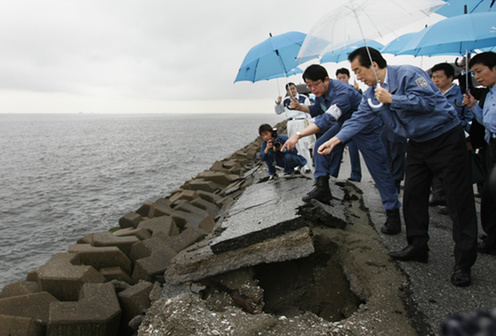
Prime
Minister Kan in Urayasu City, Chiba,
investigating the extent of the damage
there. (Cabinet Public Relations Office
photo). |
-Prime
Minister Kan's Blog
June
17, 2011
Prime
Minister Kan started hearing requests from heads
of municipalities directly by telephone as early
as March. The current series of meetings will
gather people dealing with the disaster from
both the Government and local communities. The
Government side is represented by Senior
Vice-Minister of Cabinet Office for National
Policy Tatsuo Hirano. The Prime Minister
attended the first meeting.
|
Messages
of Sympathy from Prime Minister Kan's First Town
Hall Meeting and Minister Matsumoto to the
Victims of the Tornado in Missouri,
U.S.A.
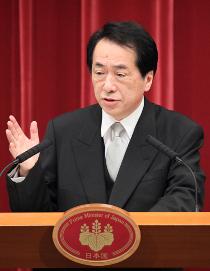 |
| Prime
Minister Naoto Kan (Cabinet Public Relations
Office
photo). |
-Ministry
of Foreign Affairs
May
24, 2011
On
Sunday, May 22, tornado hit the state of
Missouri in the U.S., causing many casualties in
the area and prompting the state to declare a
state of emergency.
In
response to this disaster, Prime Minister Naoto
Kan sent a message of sympathy to President
Barack Obama and Foreign Minister Takeaki
Matsumoto did the same to Secretary of State
Hillary Clinton on Tuesday, May 24 (Japan time).
In
those messages, they expressed their feelings of
condolence and sympathy and conveyed that Japan
is prepared to provide necessary
assistance.
|
Overcoming
Extreme Obstacles:
The True Spirit of
Journalism
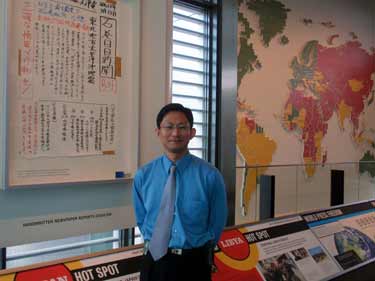 |
| Brian
Lee stands before the handwritten March 12th
Ishinomaki Hibi Shibun in the World News Gallery
of the Newseum (photo: Embassy of
Japan) |
-Susan
Laszewski
Embassy
of Japan
When
Brian Lee, Senior Administrator at the Newseum
first read in the Washington Post about the
handwritten newspapers in Ishinomaki, Japan, he
was struck by the display of journalistic spirit
they represented. He embarked on a mission to
make the papers a part of the museum's permanent
collection. The endeavor would be as close an
encounter with the true meaning of journalism as
anyone could hope for.
The
story begins with the people who crowded into a
handful of refugee centers in Ishinomaki,
Miyagi, the city now known as one of the hardest
hit by the tsunami that followed the Great East
Japan Earthquake. With the power out, there was
no reliable source of information and many were
completely in the dark as to the whereabouts of
their loved ones. Even emergency radios were
unreliable in the continuing black-out. This was
the desperate situation in which the Ishinomaki
Hibi Shimbun, declaring that as long as they
still had a marker, there was nothing stopping
them from publishing the newspaper, stepped
up.
Six
reporters took to the streets to learn what they
could. Lee was especially touched by the tale of
one reporter who was swept away in his car
while...
| |
| |